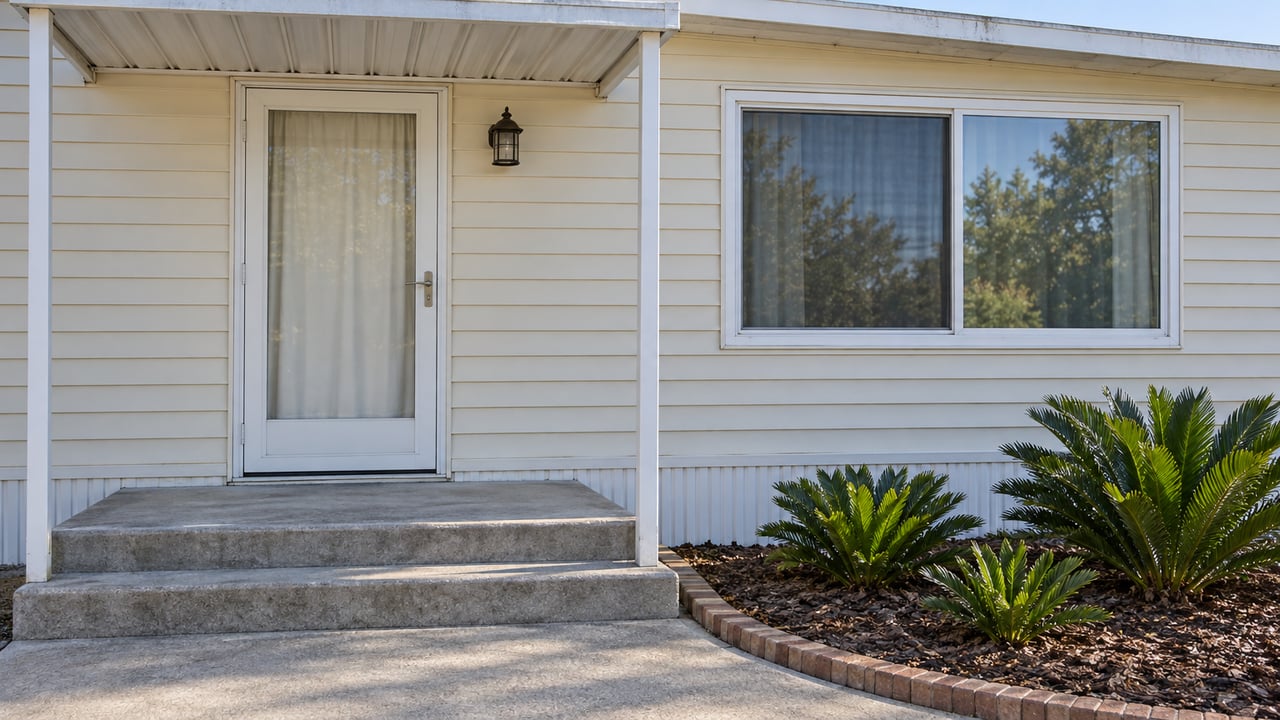
The sales history for Unit 61 at Chateau Village Co-Op, on the Manatee County Property Appraiser's parcel page, has no warranty deed in it. Each line carries a two-letter instrument code. In February 2015 the grantee was Chateau Village Cooperative, Inc. itself. Every later transfer is listed as "AL" or "PL." The appraiser's sales instrument legend defines those codes as "Assignment of Lease" and "Proprietary Lease."
That record is the clearest guide to buying at 612 53rd Ave W. A buyer at Chateau Village takes on a membership share in a corporation and a lease that grants the right to occupy one home site. That is how the county records it, and it drives the financing, the approval cost and the reserve rules that follow.
What the county file actually shows
Chateau Village Cooperative, Inc. is a Florida not-for-profit corporation. The Florida Division of Corporations record shows it was filed on November 23, 1994, with restated articles filed January 28, 2000. The association describes the property as a 55+ mobile home community of "over 275 lots" on 40 acres.
On the parcel page, the codes tell you which kind of property you're looking at:
| Field on the parcel page | What it reads for Unit 61 | What it signals |
|---|---|---|
| Neighborhood | 5144; Chateau Village Coop | The county groups these units as one cooperative |
| Land use | 0501; Single Wide MH/Co-op | A manufactured home held in cooperative form |
| Short description | Unit 61 Chateau Village, A Residential Coop | A unit within the co-op, not a platted lot |
| Instrument types | AL, PL | Assignment of Lease, Proprietary Lease |
| Living area | 750 sq ft on a 0.1395-acre site | The home and the site it occupies |
Florida's cooperative statute, section 719.103, follows the same structure. The association holds legal title. An owner's rights are shown by an ownership interest in the association, together with a lease or similar document that grants possession of a unit. So on the county's books, a Chateau Village closing is a change in who holds a share and a lease.
Who will lend against a share
A typical home mortgage is secured by real property the borrower owns. A Chateau Village buyer doesn't own the site outright. That's why Atlantic Mortgage's Chateau Village page says a standard mortgage usually doesn't fit and a bank may decline. The lender puts the community at roughly 262 to 275 homes and says most residents are shareholders.
The sources describe three ways to pay for a home here:
- A co-op share loan. Atlantic Mortgage lists Chateau Village among the Florida communities in its share-loan program. The loan is secured by the share and the proprietary lease, and the lender holds the original share certificate as collateral. The lender also says its eligibility list and program rules can change, so the listing reflects current eligibility only.
- Cash for the share. The same lender says the share and the home can be financed together in one loan. The share can also be bought with cash or may already be owned by the borrower.
- Personal-property financing for the home. HUD's Title I program covers manufactured homes treated as personal property. Its home-and-lot version requires the borrower to own the lot in fee simple, which a cooperative structure doesn't provide.
This affects buyers in practice. When a seller at Chateau Village accepts an offer, the buyer may be the one who brings cash or works with one of the few lenders set up for co-op shares. A preapproval from a typical bank may not mean much for this type of collateral.
The approval fee has a statutory ceiling
Because the buyer is joining a corporation, the cooperative usually has a say in who joins. Florida law limits what the association can charge for that review. Under section 719.106 of the 2026 Florida Statutes, a cooperative association may charge a fee for a sale, lease or other transfer only if two conditions are met: the association must be required to approve the transfer, and the cooperative documents must provide for the fee. Even then, the fee can't exceed $100 per applicant. A husband and wife, or a parent and dependent child, count as one applicant.
At Chateau Village, the cooperative's documents set the actual process. A 51-page master agreement from Chateau Village Cooperative, Inc. was recorded with the Manatee County Clerk on October 10, 2000. The association's resident news area sits behind a login. A buyer's application, approval timeline and any fee should be requested directly through the association's manager, Newby Management, at 941-755-1995.
Where Florida's reserve overhaul stops
In Bradenton's older condominium towers, the big cost questions since 2024 have come from the structural integrity reserve study, or SIRS, and the milestone inspection. Our look at The Riverview's HOA fee shows what those deadlines mean for a 1972 concrete tower. Cooperatives are covered by a parallel set of rules. HB 913, approved by the governor on June 23, 2025, revised condominium and cooperative regulation.
The current version of section 719.106 requires a SIRS at least every 10 years for each building on cooperative property that is three habitable stories or higher. It also says the requirement does not apply to buildings under three stories. Owner-controlled associations that existed on or before July 1, 2022 had a December 31, 2024 deadline for buildings that meet the height threshold. Those required to complete a milestone inspection on or before December 31, 2026 may finish the SIRS alongside it, and the statute says no SIRS may be completed after December 31, 2026, about ten weeks away. The official HB 913 bill summary applies the same three-habitable-story threshold to milestone inspections of cooperative buildings.
The county classifies Unit 61 as a single-wide manufactured home. That's a very different building type from the towers these deadlines were written for. The parcel record doesn't list story counts, though, and the statute turns on building height. Whether any building on the cooperative property reaches three habitable stories is something to confirm in writing with the association and your attorney.
Other reserve rules still apply. The same statute requires a cooperative's budget to include reserve accounts for roof replacement, building painting and pavement resurfacing. It also requires reserves for other items whose replacement or deferred maintenance cost exceeds $25,000 or the inflation-adjusted threshold. Owners can vote by majority to fund less than the statutory amount where the SIRS rules don't apply. Even at a co-op made up of manufactured homes, the budget and reserve schedule are worth reading.
An assessment in place of lot rent
The lease structure also changes the monthly bill. In a rented-lot park, an outside owner holds the land and residents pay rent. Star Mobile Home Park, a 31-unit community at 204 41st Avenue E in Bradenton, publishes 2026 lot rent of $625 a month, with lawn service and trash removal included and water and sewer billed separately. Residents of a resident-owned co-op own the land together through the corporation and pay no lot rent. Instead they pay a monthly cooperative assessment, which a share lender includes alongside taxes and insurance when qualifying a borrower.
Neither the association nor its lender page publishes Chateau Village's assessment amount, so you can't compare it to a park's rent from the outside. The useful comparison is what each payment covers. Lot rent pays a landlord. A co-op assessment funds the corporation the buyer is joining, including the reserve accounts described above.
Before writing an offer on a Chateau Village home, ask the association or the listing side for these documents:
- The proprietary lease and share certificate terms for the specific unit.
- The current monthly assessment and what it includes.
- The adopted budget, with its reserve accounts and any vote to reduce reserve funding.
- The transfer application, the approval steps and any fee the cooperative documents provide for.
- Written confirmation from a share lender that the community and the home currently qualify, if you're not paying cash.
This post is general information about how cooperative ownership is recorded and regulated in Florida, not legal, tax or financial advice. Please confirm the details of your own purchase with a Florida real estate attorney, your lender and your tax professional.
If you're weighing a resident-owned co-op against a condo or a rented-lot park, Smith Garcia Group can pull the parcel record, line up the documents above and walk through what the share-and-lease structure means for your timeline and your financing. Schedule Your Market Consultation and bring the unit number you're considering.