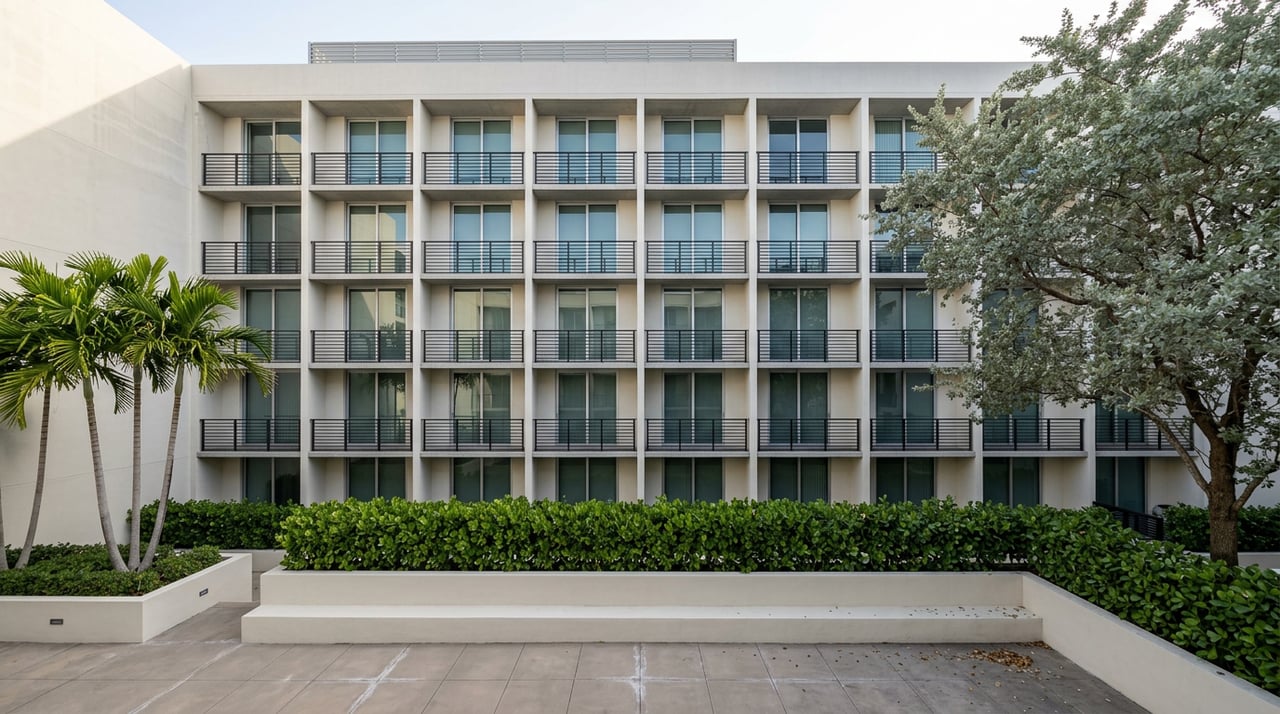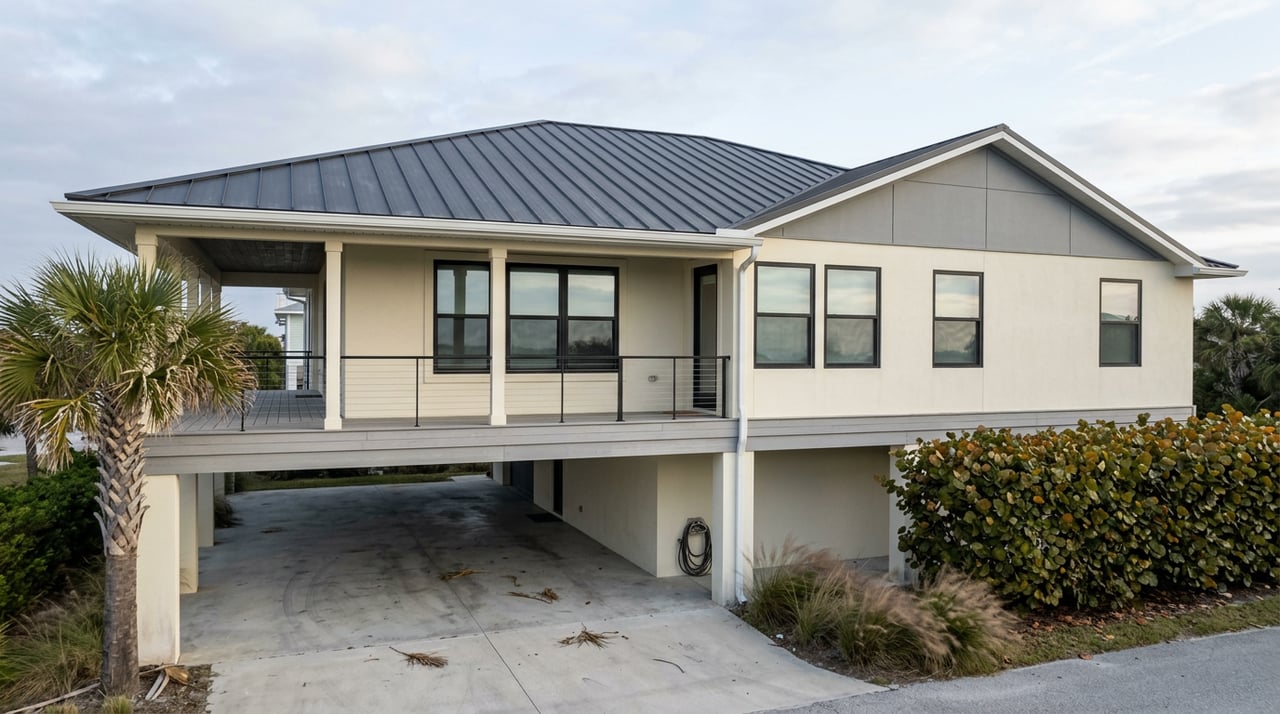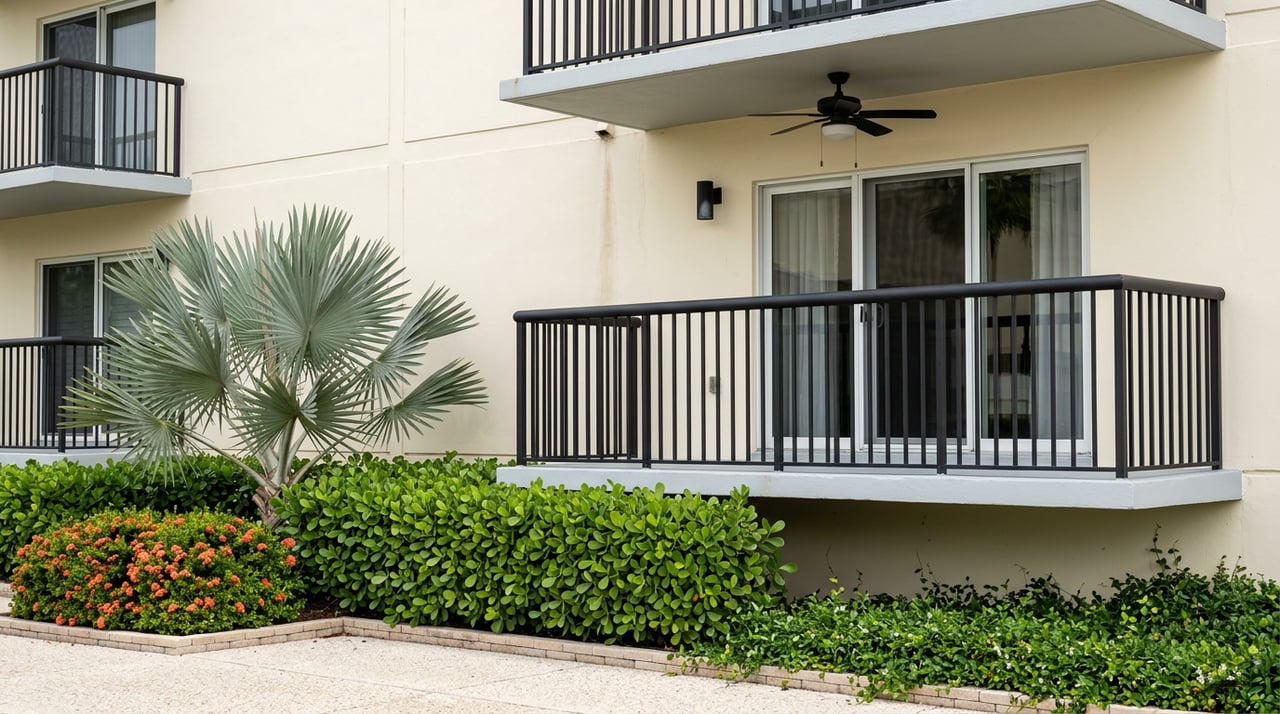
A buyer touring two Bradenton properties in the same afternoon sees "balcony" on both listing sheets and assumes it is the same feature priced two different ways. One is a fourth-floor unit in a coastal condo building. The other is a single-family home near Manatee Avenue with a second-story deck off the primary bedroom. Both list balconies. Neither disclosure sheet tells you that the two balconies live under completely different sets of rules, and that gap is exactly where a deal can go sideways at inspection or renewal.
The condo balcony sits inside a structure with an association, a reserve fund, and, as of this year, a state-mandated engineering study that treats waterproofing and railing connections as line items with dollar figures attached. The single-family balcony sits inside none of that. It belongs entirely to the person who signs the deed, backed by whatever a standard homeowners policy happens to cover on the day a leak shows up. Same word. Different bundle of obligations.
The Law That Changed What "Balcony" Means for Condo Owners
Florida's Structural Integrity Reserve Study requirement, created after the Champlain Towers South collapse and refined through HB 913, applies to condominium and cooperative buildings with three or more habitable stories. The study covers eight components: roof, load-bearing structure, fire protection, plumbing, electrical, waterproofing, windows and doors, and any other item whose failure would compromise those systems and whose cost exceeds a threshold that gets adjusted for inflation each year. For 2026, that threshold sits above $25,675.
Balconies are not a named category by themselves, but they show up constantly inside the waterproofing and structural findings. Engineers who perform these studies routinely flag deteriorated balcony slabs and railing connections as some of the most common defects in coastal Florida buildings, right alongside concrete spalling and rebar corrosion from salt exposure. A balcony that looks fine from the parking lot can still be sitting on a membrane that failed years ago.
What makes this a live financial issue rather than a paperwork exercise is the insurance tie. Citizens Property Insurance Corporation is now barred from issuing or renewing a policy for a condominium unit or association that is not current on both its milestone inspection and its SIRS obligations. Private carriers have largely adopted the same posture, often asking for a SIRS summary page before they will even quote. If the building's balcony waterproofing shows up as a deficiency and the association has not funded the fix, that is no longer just a maintenance conversation at a board meeting. It is a reason a policy does not renew.
What Bradenton Beach Just Did With That Rule
State law tells associations what to study. It leaves the job of tracking who actually complies to individual cities and counties. Bradenton Beach adopted its version of that tracking mechanism this year with City Ordinance 26-566, finalized on second reading March 19, 2026.
The ordinance does something worth understanding if you are shopping condo listings anywhere in this part of Manatee County, because it shows how these rules get sorted on the ground. City Attorney Erica Augello's draft required every qualifying condo and co-op building to register with the city's Building and Planning Department, and the registration threshold is wider than the actual inspection trigger. The ordinance requires buildings that are:
"two stories in height – including parking levels as a floor – and taller"
to register by July 1, 2026, even though the state's actual milestone inspection requirement only kicks in at three or more habitable stories. That distinction matters because a lot of local buildings are three stories by casual counting but only two habitable floors sitting above a non-habitable parking level. The city wanted a full inventory first, then the building official sorts out which registered buildings actually cross the habitable-story line and which ones are exempt by design.
That July 1 registration deadline has now passed. Every qualifying building in Bradenton Beach should be on file with the city, sorted by habitable-story count, with association contact information on record. That registration list is a document a buyer can now ask about before writing an offer on a condo in that market, the same way you would ask for the SIRS report itself.
Two Balconies, Two Sets of Rules
| Condo balcony (3+ habitable stories) | Single-family or townhome balcony | |
|---|---|---|
| Structural oversight | Covered by SIRS waterproofing and structural review, refreshed at least every 10 years | No state structural study requirement |
| Who funds repairs | Association reserves, mandatory funding since January 1, 2026 for most budgets | The homeowner directly |
| Insurance leverage point | Citizens and most private carriers require SIRS/milestone compliance to renew | Standard HO-3 policy, subject to normal exclusions |
| Common claim risk | Deficiency flagged in engineering report, funded through reserves or special assessment | Gradual leak often classified as a maintenance issue and denied |
| Public paper trail | SIRS and milestone reports are part of the association's official record and must be shown to buyers | No equivalent public filing |
The insurance row is where single-family buyers get caught off guard. Standard HO-3 policies in Florida cover sudden and accidental water damage, the kind that comes from a burst pipe or a storm that tears through a roof in one event. A slow drip behind a balcony door track that has been working its way into the wall for eight months is a different animal. Carriers routinely treat that as a maintenance failure rather than a covered loss, and that denial holds up more often than homeowners expect, because the policy language was written for sudden events, not slow ones.
If a storm does cause the damage, the clock starts moving fast. Florida Statute 627.70132 gives you one year from the date of loss to file a new or reopened claim and eighteen months for a supplemental claim. Those deadlines replaced the longer windows many people still assume apply, so a homeowner who waits to see if a small balcony leak gets worse before filing can run out the clock without realizing it.
Why the Public Record Now Works in Your Favor
Here is the part of this that actually helps a buyer rather than just adding friction. Florida law requires that structural inspection reports and reserve studies become part of a condominium association's official record and be provided to potential purchasers. That was not always practical to enforce, but the combination of the state's online DBPR reporting requirement and local registration ordinances like Bradenton Beach's means this information is easier to pull than it was even two years ago.
That changes how a buyer should approach a condo listing with a balcony. Instead of taking the listing photo at face value, you can request the association's most recent SIRS, its milestone inspection status, and confirmation of where the building falls on the local registration list, all before you are deep into a contract. A softer 2026 market gives buyers more room to make that request part of the negotiation rather than an afterthought, since sellers and associations have less leverage to brush past it when inventory sits longer.
For a single-family home, the equivalent homework looks different. There is no SIRS to request. What you want instead is a clear look at how the balcony was built, whether permits were pulled for it, and how the current owner has maintained the waterproofing underneath the decking. That is a job for a private inspector rather than a public filing, and it is worth treating with the same seriousness as a roof inspection.
Three Questions to Ask Before You Write an Offer
Is this building actually subject to SIRS, or does it fall under the habitable-story exemption? Ask for the certificate of occupancy date and confirm the habitable-floor count with the association or the city building official rather than assuming from the outside.
When was the last SIRS or milestone inspection completed, and what did it say about waterproofing and balconies specifically? A clean report from three years ago on a coastal building is worth less than a recent one, given how quickly salt air accelerates deterioration.
For a single-family balcony, who built it and when, and is there a permit on file with the county? An unpermitted addition changes both your insurance conversation and your resale story later.
None of this is a reason to avoid balcony listings in Bradenton. Waterfront and near-waterfront properties with outdoor living space remain some of the most sought-after inventory on this stretch of the Gulf Coast. The point is narrower than that. The word on the listing sheet does not tell you which rulebook applies, and the rulebook determines who pays, who inspects, and how fast your insurance clock runs if something goes wrong.
If you are comparing a condo balcony against a single-family one in Bradenton and want a clear read on what each one actually commits you to, the team at Smith Garcia Group can walk through the specific building's SIRS status, registration record, and insurance posture before you write an offer. Schedule Your Market Consultation and bring the listing sheets. We will tell you which balcony is which.