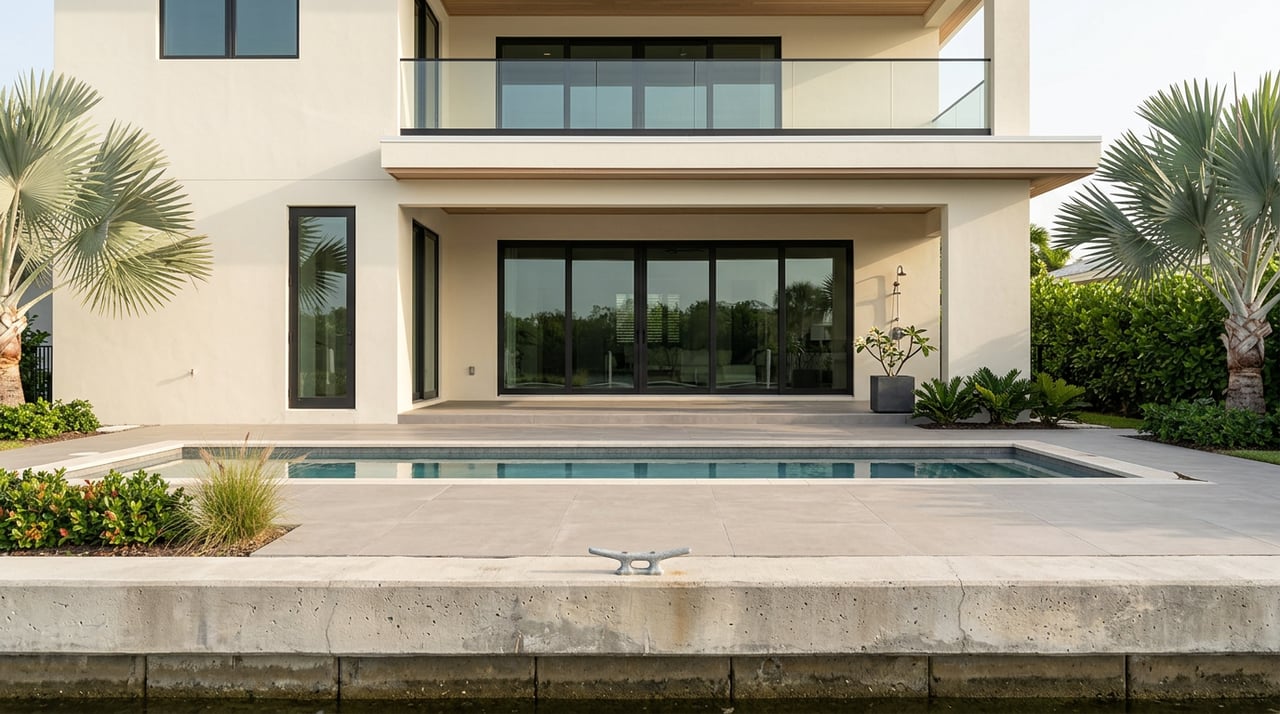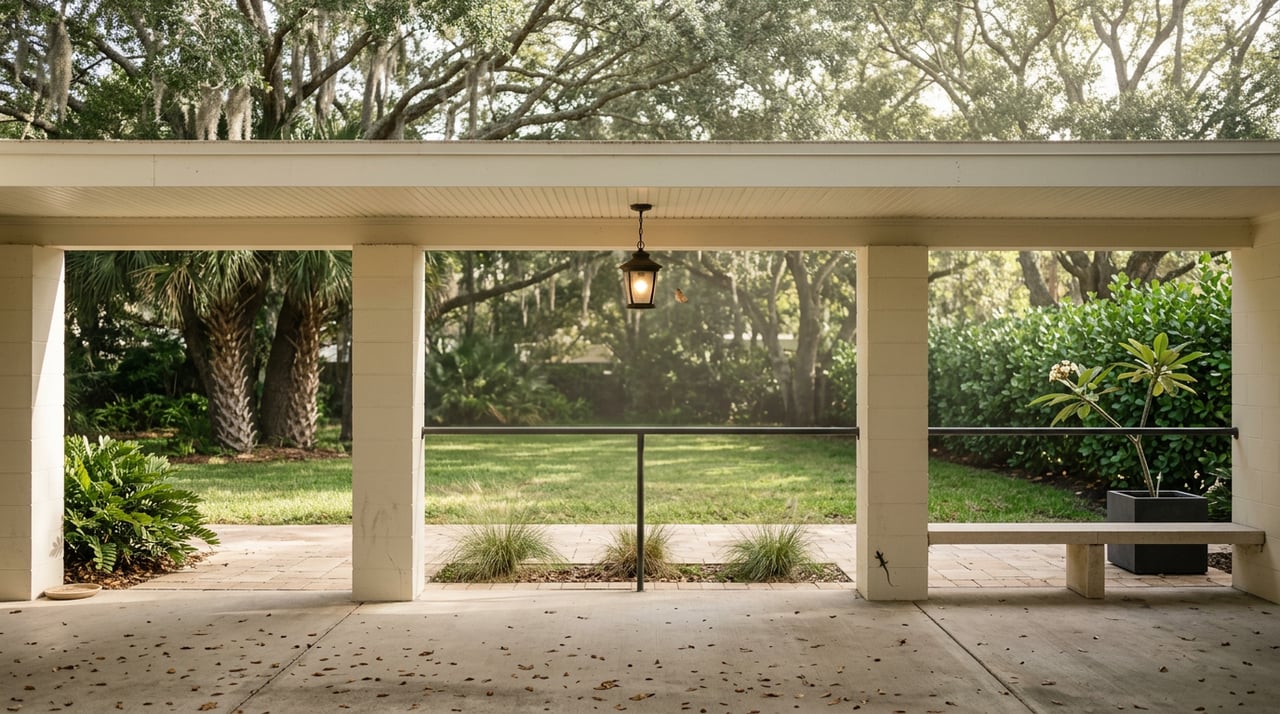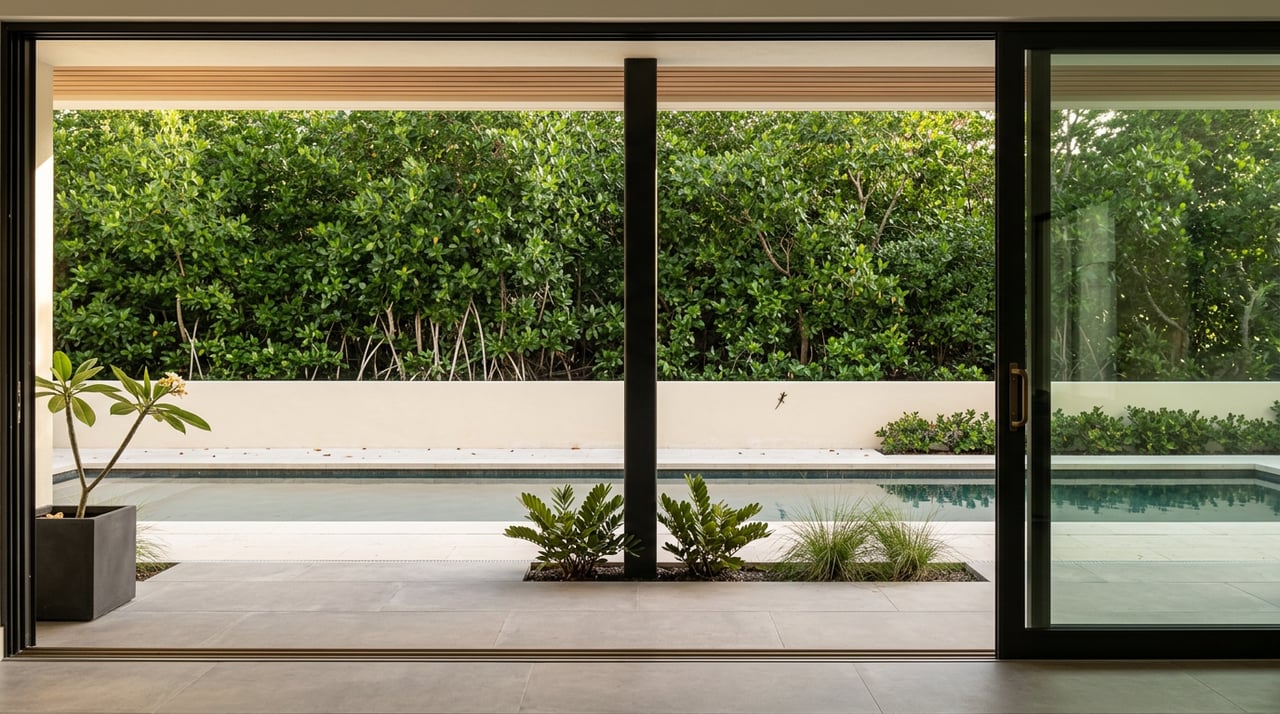
The listing photo shows a dock, a skiff, and a wall of green behind the seawall. The price reflects all three. What the photo doesn't show is that Florida statute decides how much of that green you're allowed to cut, a federal agency decides whether the dock can be rebuilt, and an underwriter decides what the whole thing costs to hold.
Warner's Bayou is the case study. Three connected bayous flowing out to the Manatee River, the Intracoastal, Tampa Bay, and the Gulf, with 1920s Old Florida cottages sitting a few lots away from newer Key West and Mediterranean estates. It looks like one market. It prices like three, because the frictions attach to the parcel, not the neighborhood.
The thesis: on a Bradenton bayou, you are not buying a view and a dock. You are buying a bundle of state, federal, and underwriting permissions that constrain both. In a softer 2026 market, the buyers who win are the ones who price each permission separately.
The view is regulated, and most sellers don't mention it
Mangroves are the amenity and the constraint at once. They stabilize the shoreline, they are the reason the bayou has fish, and they are the reason your sightline to open water may be shorter than the drone footage suggests.
Under the Mangrove Trimming and Preservation Act, a waterfront owner has a recognized "riparian right of view" but only a narrow set of exemptions to act on it without a permit. The exemptions apply to the Riparian Mangrove Fringe, which is the band of mangroves growing within roughly 50 feet of the shoreline as measured perpendicular to the water. Inside that band, an owner can trim trees between 6 and 10 feet in pretrimmed height down to no less than 6 feet. On shorelines of 150 feet or more, no more than 65 percent of the mangroves along that shoreline can be trimmed. Anything over 10 feet pretrimmed must be handled by a state Professional Mangrove Trimmer.
Two consequences follow for a bayou buyer.
First, the mature Warner's Bayou lots most attractive to view-driven buyers are exactly the lots where mangroves are tallest and oldest, which is where the permit-free path ends. Second, "alter" in the statute means removal, defoliation, or destruction, and it applies even to seedlings colonizing under an established canopy. Pulling volunteers out of the substrate is technically alteration. That matters at resale, because a buyer's inspector or a neighbor can flag past alteration and trigger enforcement that runs with the property, not the prior owner.
If a listing markets a "cleared water view," treat it as a claim to verify against county and FDEP records, not a feature to price at face value.
"Boatable" is a permit chain, not a checkbox
Warner's Bayou drains into waters the state has designated Outstanding Florida Waters, including Palma Sola Bay, Anna Maria Sound, and Perico Bay. That designation isn't decorative. It sits on top of dock construction and seawall work like a second layer of rules.
For a single-family dock in an Outstanding Florida Water or Aquatic Preserve, FDEP guidance and long-standing state practice require water depths sufficient to keep at least one foot of clearance between the top of any seagrass in the vicinity and the lowest point of the moored vessel. The U.S. Army Corps of Engineers also holds jurisdiction, and in waters frequented by manatees, the Corps has declined dock permits in the absence of an approved local manatee protection plan.
For a bayou buyer, that means the actual dock question isn't "does the seller have a dock." It's a chain of separate approvals:
- FDEP or delegated local authority for construction in state waters
- USACE for federal jurisdiction where manatees and seagrass are present
- Manatee County for local building permits and seawall connections
- The existing seawall itself, and whether an insurance carrier will underwrite the property with it in place
Any one of those can turn a dock replacement, a seawall repair, or a lift upgrade from a weekend project into an eighteen-month permit exercise. Manatee County's own work at the Warner's Bayou Boat Ramp is instructive. When the county announced the ramp expansion, the plan included a 48-foot dock extension paired with living-shoreline components, mangrove plantings, and oyster bars. That is the current permitting reality even for a public agency working on its own property.
A prudent offer on a bayou home with an existing dock includes a contingency period long enough to pull the permit history and confirm that the structure as built matches what's on file. A dock that was legal in 1988 is not automatically legal to replace in 2026.
The carrying-cost stack no one prices at showing
The Bradenton waterfront insurance picture in 2026 is bifurcated. Standard inland Manatee County single-family policies are still quotable in a normal range. Coastal and older-roof properties are not, and bayou frontage puts a parcel closer to the coastal profile than the inland one, regardless of the ZIP code on the deed.
A few numbers worth pricing into an offer:
| Cost line | Where it lands in 2026 |
|---|---|
| Manatee County median home insurance, standard risk | Roughly $1,000 to $1,400 annually |
| Bradenton Beach coastal-profile premium | $4,630 at higher deductibles up to $8,610 at $500 deductible |
| Florida title base premium | $5.75 per $1,000 to $100K, then $5.00 per $1,000 above |
| Waterfront title endorsement load | Roughly 10 percent added for flood, seawall, riparian |
| Manatee County settlement fees | $395 to $950 depending on complexity |
| Citizens personal residential policies remaining in Manatee | About 5,700 as of May 31, 2026, and shrinking |
Two dynamics inside that table matter more than the individual figures.
The first is roof age. Buyers in West Bradenton have watched insurance quotes move from around $1,200 to $4,800 mid-underwriting once the carrier reviewed roof age and the wind mitigation report. On a bayou lot with a 1920s cottage or an early Key West build, the roof and elevation drive the number, not the address.
The second is Citizens. The state-backed insurer of last resort has continued to shrink in Manatee County, and Citizens has told remaining personal residential wind policyholders that flood coverage is mandatory by January 1, 2027. If a bayou property currently sits on a Citizens wind policy without flood, the true 2027 carrying cost is not what the seller is paying today.
Title work has its own bayou-specific line items. Flood, seawall, and riparian rights endorsements are common on Anna Maria Island and Bradenton Beach transactions and appear regularly on Warner's Bayou closings for the same reasons. Ordering a preliminary title commitment early enough to see the endorsement stack, rather than at the end of due diligence, is the difference between negotiating the cost and absorbing it.
Why a softer 2026 market lets buyers actually price these
None of the frictions above are new. What is new is the negotiating room to reflect them in an offer.
Manatee County single-family closed sales were down 10.8 percent year over year in early 2026, with the median edging up 0.1 percent to $480,495 and new pending sales up 17.4 percent. Sellers were accepting an average of 94 percent of original list, and homes were sitting 50 to 76 days depending on tier. That combination — thinner closings, real pending activity, list-to-sale slippage, meaningful days on market — is the setup that lets a bayou buyer structure an offer around three separate contingencies rather than one blanket inspection period:
- A view contingency tied to a mangrove survey and any existing FDEP or local trimming authorizations.
- A dock-and-seawall contingency tied to the permit history and, if replacement is contemplated, a preliminary conversation with FDEP and USACE.
- An insurability contingency tied to a binding quote, not a soft indication, with roof age and wind mitigation form OIR-B1-1802 already in the underwriter's hands.
In a 2021 market, sellers rejected offers structured that way. In the current market, they read them.
FAQ
Does "waterfront" in a listing mean I own to the water? Not necessarily. Florida owns navigable waterways up to the high-water line. A deed can describe the parcel as waterfront while the legal boundary stops at a seawall or a mean high water line. Confirm the boundary in the title commitment, not the MLS description.
If mangroves block my view, can I remove them and replant elsewhere? No. "Alter" under state statute includes removal, defoliation, and destruction, and applies even to seedlings. Trimming inside the exemptions is one thing. Removal is a separate permit question with a much higher bar in Outstanding Florida Waters.
Is a Citizens takeout offer good news for a bayou buyer taking over a policy? It depends on the takeout carrier's financial strength, its rate path, and whether the policy carries flood. The January 1, 2027 flood mandate on Citizens wind policies means a bayou property without flood coverage today has a repricing event on the calendar.
What's the single most useful document to request early? The permit history for the dock, seawall, and any prior mangrove authorizations, pulled from Manatee County's Accela portal. A clean file is worth a real price concession. A messy file is worth a bigger one.
Bayou frontage in Bradenton rewards buyers who treat the amenity and the constraints as one purchase. If you're evaluating a Warner's Bayou property, or comparing a bayou lot against a canal or open-bay alternative, the team at Smith Garcia Group will read the permit history, the endorsement stack, and the current market with you before you write the offer. Schedule Your Market Consultation.