Three days before closing on a home in West Bradenton this summer, a buyer's insurance quote jumped from $1,200 to $4,800. Nothing about the house had changed. The walls were the same concrete block they had always been. The roof was the same age it had been at the time of the offer. What changed was the underwriter's read on the wind mitigation report, and by the time that read landed, the buyer had days, not weeks, to renegotiate or walk.
That kind of last-minute swing is becoming familiar to anyone shopping Manatee County this year, and it points to something buyers consistently get backwards. They see "block construction" in a listing and treat it as a shortcut to a favorable insurance rate. In Bradenton, that shortcut barely exists, because block construction isn't the differentiator. It's the default.
Block Is the Floor, Not the Discount
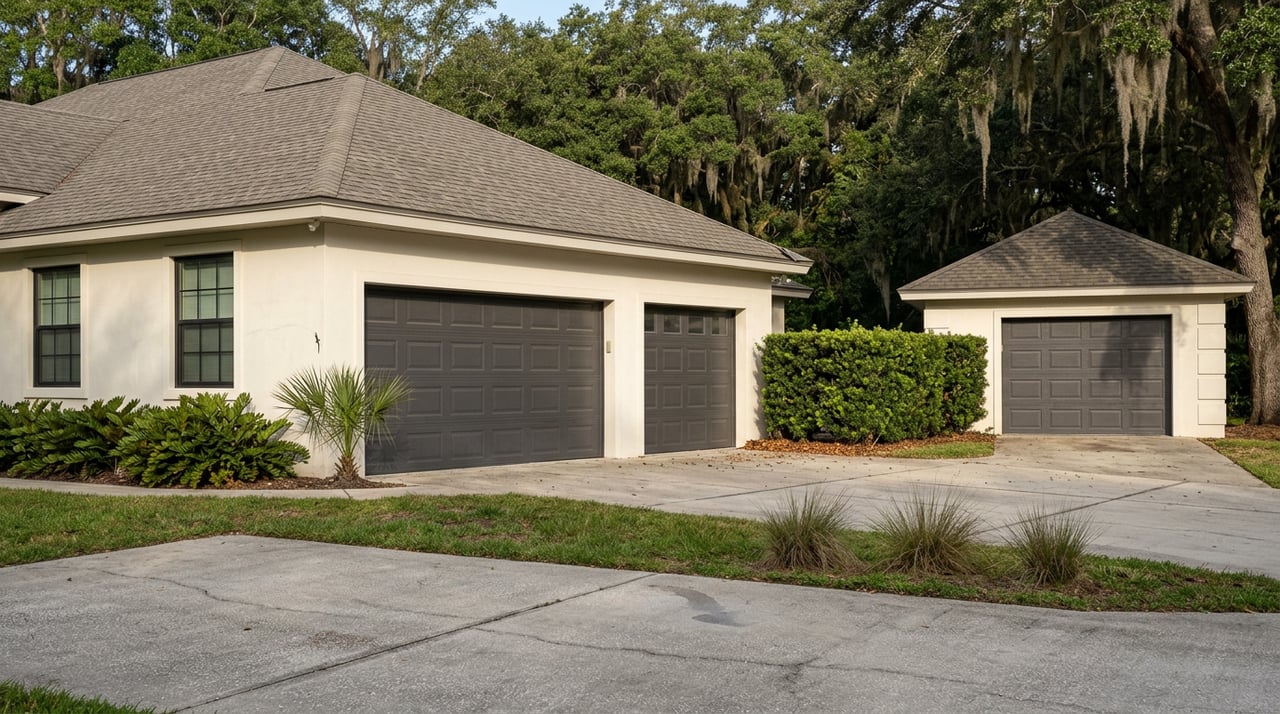
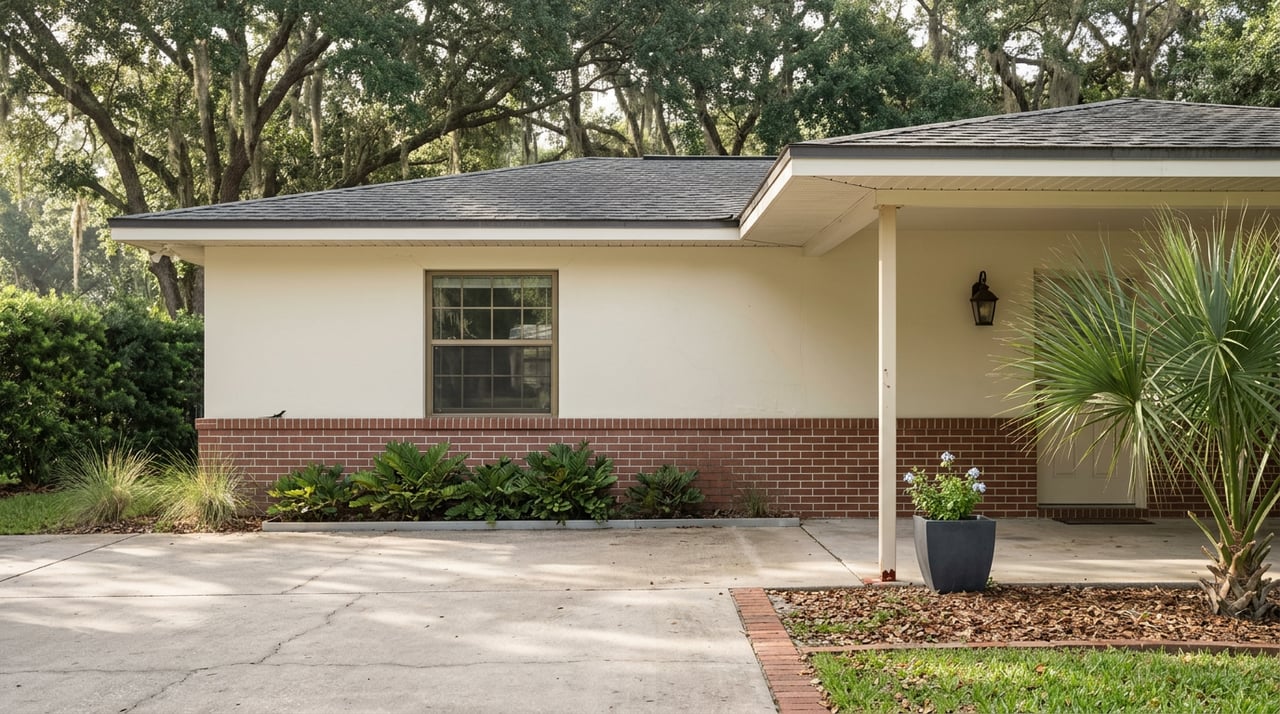
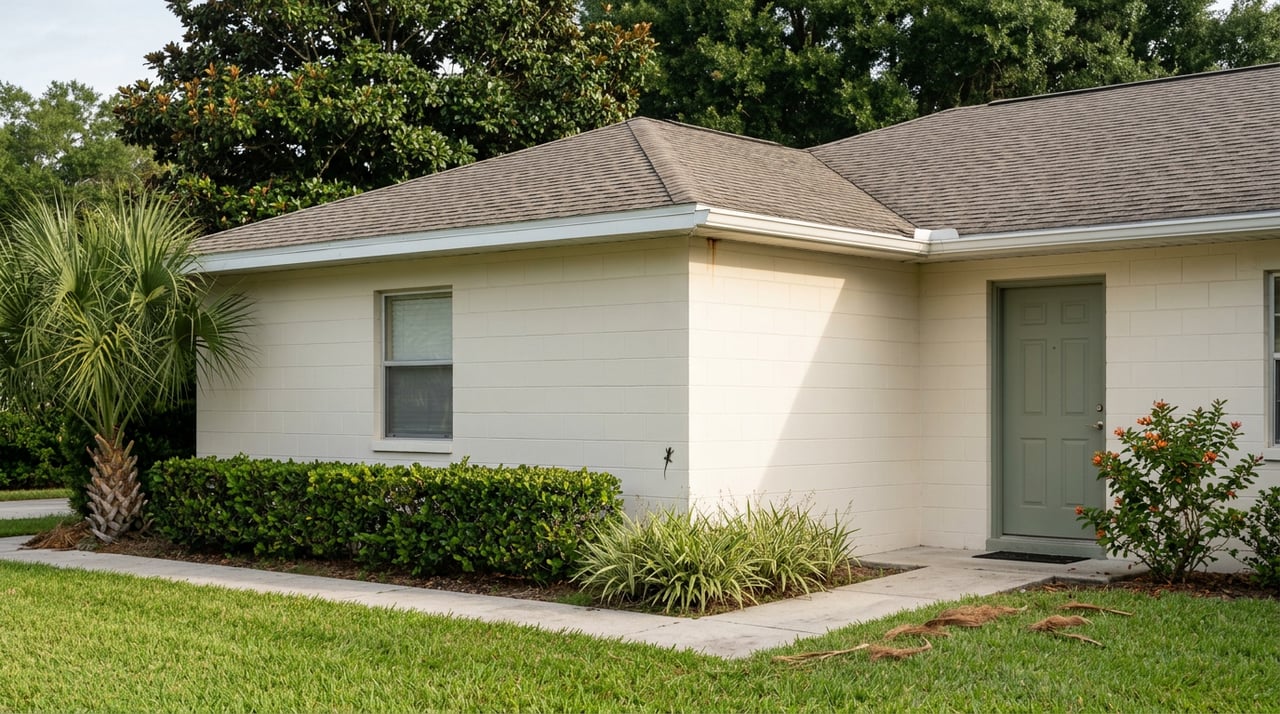
Concrete block, or CBS construction, has been the standard building method across Manatee County since Hurricane Andrew forced a rewrite of Florida's building code in the early 1990s. Ask a local underwriter what percentage of Bradenton's single-family stock is block and the honest answer is nearly all of it. That's exactly why block, by itself, doesn't move your quote. Insurers already assume it.
Florida Statute 627.0629 requires every insurer writing homeowners coverage in the state to apply discounts for verified wind-resistant features, but "concrete block wall" isn't one of the categories the inspection form actually scores. The categories that move a premium are roof shape, roof deck attachment, roof-to-wall connection, secondary water resistance, and opening protection. A block home with a flat gable roof and unprotected windows can price out worse than a wood-frame home with a hip roof and impact glass on every opening. The wall material sets a floor. The documented features above it set the ceiling.
The Form That Actually Sets Your Rate
The mechanism that determines whether a Bradenton buyer pays $1,600 a year or $3,000 a year is the wind mitigation inspection, documented on Florida's Uniform Mitigation Verification Inspection Form, known by its form number, OIR-B1-1802. That form got its first substantial revision in over a decade this year, based on a 2024 statewide study of real-world hurricane performance data, and the revised version became mandatory for every inspection completed on or after April 1, 2026.
The inspection itself is not expensive. It typically runs $100 to $150, takes under an hour, and the resulting report stays valid for five years unless the home undergoes structural changes. Homes built under the 2001 Florida Building Code, which took effect March 1, 2002, automatically qualify for meaningful default credits without any extra paperwork. Older homes can still earn credits, but only if someone documents the features with the new form's tighter evidence standards, including permit numbers and product approval codes for roofs, windows, and doors.
Why August 2026 Is an Odd Moment to Be Under Contract
Here's the part that makes this year unusual rather than routine. The new form became mandatory April 1, 2026, but insurers didn't start applying credits calculated under the revised tables until roughly July 2026. That created a window, now closing, where a homeowner could complete a fresh inspection under the stricter form and see no change on their bill for months, simply because carriers hadn't caught up yet on the underwriting side.
If you're closing this month, you're on the other side of that gap. Carriers are actively running the new credit tiers now, which means the documentation quality on a seller's existing report matters more than it would have in the spring. An older report completed under the previous form can still be honored for its full five-year window if nothing structural has changed, but if a roof was replaced or windows were swapped out since that report was filed, the improvement may not show up in the seller's current premium at all. That's the trap the West Bradenton buyer fell into. The wind mitigation report on file didn't reflect the roof's actual condition closely enough for the new underwriting review to give full credit, and the quote reset accordingly, four days before closing.
What the Zip Code Average Hides
Buyers often try to shortcut this by asking which Bradenton zip code is cheaper to insure. The honest answer is that the data providers don't even agree with each other. One insurance-quote aggregator's figures for 34203 show a range of roughly $1,592 to $2,981 depending on roof age and home size, while the same source's figures for 34210 show a similar range of about $1,578 to $2,967. A separate insurance agency's ranking, by contrast, names 34210 the most expensive zip code in Bradenton and 34211 the least expensive. Both sources are working from real underwriting data. They still land in different places.
That disagreement is the point. Zip code correlates loosely with coastal exposure, but it explains far less of your actual premium than the condition of your specific roof and whether that roof's features were ever formally verified. Two houses across the street from each other in the same zip code can carry premiums thousands of dollars apart if one has a documented hip roof with full opening protection and the other has an undocumented gable roof from 2004.
| Zip Code | Approx. Area | Illustrative Annual Range | What Drives the Spread |
|---|---|---|---|
| 34203 | Inland East Bradenton | ~$1,592–$2,981 | Roof age and size dominate over location |
| 34208 | East Bradenton | ~$1,280–$2,349 | Lower coastal wind exposure |
| 34210 | West Bradenton, near coast | ~$1,578–$2,967 (one source) vs. "most expensive in Bradenton" (another) | Sources disagree on ranking |
Figures reflect 2026 online quote estimates and one insurance agency's comparative ranking. Treat both as directional, not as a substitute for a binding quote on a specific address.
Before You Write an Offer
- Ask for the seller's current wind mitigation report and its inspection date. If it predates April 1, 2026, confirm whether any roof, window, or door work happened since.
- Confirm the report includes permit numbers and product approval codes for the roof and any impact-rated openings. Missing documentation is now the most common reason a credit gets denied.
- Get a binding insurance quote before your inspection contingency expires, not after. A quote that arrives after you've waived contingencies leaves you with far less room to renegotiate.
- If the home currently carries a Citizens Property Insurance policy, ask directly whether it's a personal residential multiperil policy or a wind-only policy, since the path to replacing each differs.
- Ask whether the seller used the My Safe Florida Home program, which offers matching grants up to $10,000 for qualifying hurricane hardening work. A documented grant-funded upgrade is often the cleanest paper trail an underwriter can review.
The Citizens Wildcard
Citizens Property Insurance, the state's insurer of last resort, has been shrinking fast in Manatee County. As of May 31, 2026, Citizens carried roughly 5,700 personal residential policies in the county, split between about 5,285 multiperil policies and 366 wind-only policies, after more than 546,000 policies were assumed by private insurers statewide through 2025's depopulation program. If a listing you're considering still carries a Citizens policy, expect it to move to a private carrier before or shortly after closing, and expect that quote to look different from what the seller has been paying.
One deadline worth flagging for anyone buying a Citizens-insured property near the coast: every remaining Citizens personal residential wind policy is required to carry flood coverage by January 1, 2027. If you're inheriting a wind-only Citizens policy on a West Bradenton or barrier-island property, that flood requirement is coming whether or not you've budgeted for it yet.
The stakes here aren't hypothetical. Hurricane Helene caused more than $350 million in damage in unincorporated Manatee County alone and destroyed 594 structures, with officials estimating that storm surge damaged 90 to 95 percent of Bradenton Beach. That kind of exposure is exactly why getting the wind mitigation paperwork right, rather than assuming block construction speaks for itself, is worth the time before you sign anything.
FAQ
Does a new roof automatically lower my premium? Not by itself. The roof has to be documented on a current wind mitigation inspection, ideally with the permit number and installation date attached, before an insurer will apply the credit.
My wind mitigation report is from 2022. Is it still good? Generally yes, for up to five years, as long as no structural changes have been made to the home. Because the form changed substantially in April 2026, a fresh inspection may now surface additional credits your 2022 report never captured, particularly around opening protection.
Is flood insurance covered by any of this? No. Wind mitigation and flood insurance are entirely separate policies rated on different criteria. Given Manatee County's proximity to the Manatee River, the Braden River, and Tampa Bay, most buyers here carry both.
Insurance underwriting has become one of the most consequential parts of a Bradenton closing, and the difference between a smooth one and a scramble usually comes down to documentation you can gather weeks before you ever need it. If you're comparing Bradenton neighborhoods and want a clearer read on what a specific property's construction and mitigation history actually means for your bottom line, the Smith Garcia Group team works these details into every offer strategy. Schedule your market consultation and let's look at the paperwork before you write the offer, not after.