Why does a driveway with two garage doors instead of one draw three offers before the sign goes up? Ask around and you'll hear about car collectors, workshop hobbyists, maybe a contractor who needs to park a truck. That story is only partly true, and it misses the mechanism that actually drives the premium: a legal workaround for boat and RV storage that most buyers, and more than a few HOA boards, still get wrong.
The Law Everyone Cites, and the Boat It Doesn't Cover
Florida passed a wave of HOA reform in 2023 and 2024, and the headline version that circulated among homeowners was simple: associations can no longer stop you from parking your personal vehicle in your own driveway. That's true, but it's a narrower rule than most people assume.
The statute homeowners actually quote when they want to keep a boat or RV at home is Section 720.3045, added in 2023. It says an association cannot restrict an owner from storing certain items, including boats and recreational vehicles, if those items aren't visible from the parcel's frontage, an adjacent parcel, an adjacent common area, or a community golf course. It's a visibility rule, not a parking right.
A separate law, Section 720.3075(3)(d), was added through House Bill 1203 and took effect July 1, 2024. This is the one that actually protects driveway parking, and it covers personal vehicles, including pickup trucks, and non-commercial work vehicles. Florida attorney Joe Adams of Becker & Poliakoff addressed the confusion directly, noting that the driveway statute only applies to personal vehicles and work vehicles and would not apply to boats or boat trailers. Two different statutes, two different rules, and only one of them puts a boat anywhere near your driveway legally.
| Statute | Effective | Protects | Does not cover |
|---|---|---|---|
| Fla. Stat. § 720.3045 (storage statute) | 2023 | Boats, RVs, and other listed items stored out of view of frontage, adjacent parcels, or common areas | Boats or RVs visible from the street or a neighbor's lot |
| Fla. Stat. § 720.3075(3)(d) via HB 1203 (driveway statute) | July 1, 2024 | Personal vehicles and non-commercial work vehicles parked in the driveway | Boats and boat trailers |
If you own a boat and assumed the 2024 law gave you a right to park it in the driveway, it didn't. Your protection depends entirely on whether the vessel can be hidden from view, which is a very different problem to solve.
What Manatee County Actually Enforces Day to Day
State statute sets the ceiling, but the county code is what a code enforcement officer actually applies on a Tuesday afternoon. Manatee County classifies boats, RVs, trailers, and any vehicle with two or more amenities for living as a "restricted vehicle." Under the county's code, restricted vehicles are allowed in a driveway for a short time when a resident is preparing for or returning from a trip, and that window is tight: twice in a 30-day period, with each stay capped at three days.
That's the friction that actually shapes buyer behavior in this market. A boat that's visible from the street for more than three days, more than twice a month, is a code violation regardless of what the 2024 parking law protects. The only durable fix is getting the vessel out of sight entirely, either behind a fence line deep enough to block the view from the road and from neighboring parcels, or inside a structure built to fit it.
Why the Garage Becomes the Workaround
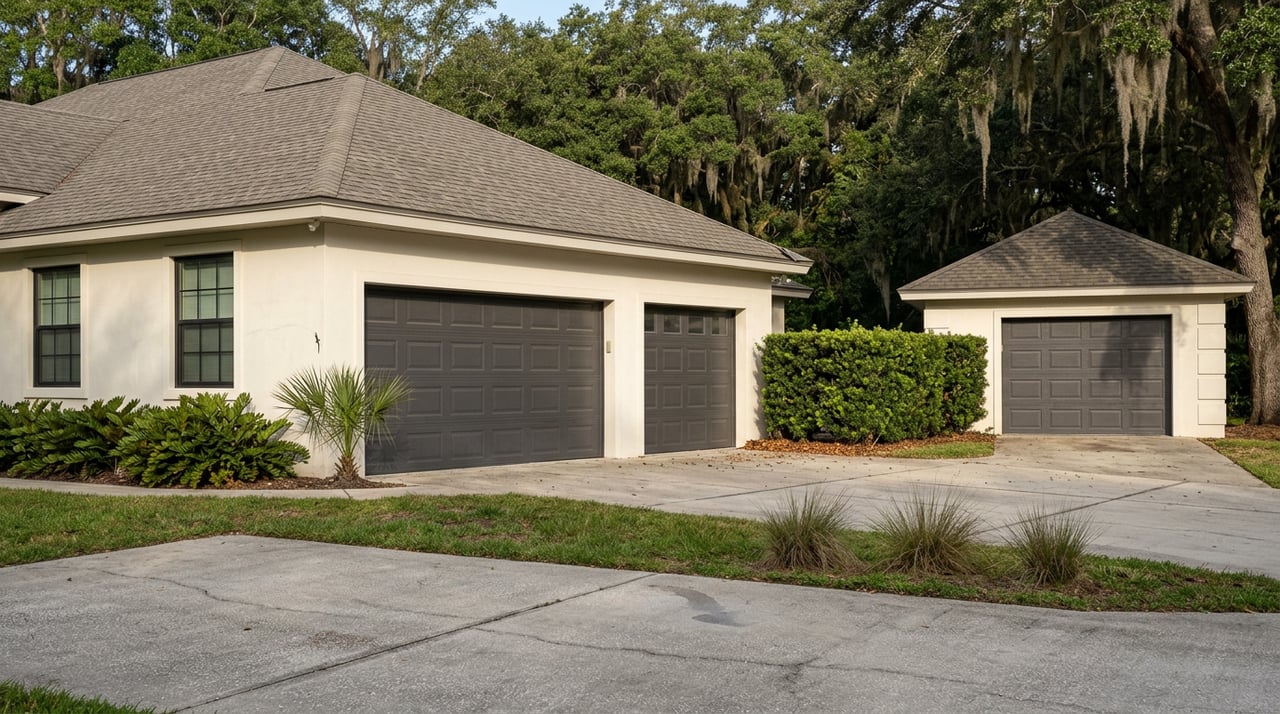
This is where the garage math gets interesting. A standard two-car garage doesn't fit a 24-foot center console or a Class C motorhome. A five-car footprint, or a configuration split across an attached and a detached structure, does. One Bradenton listing in the Mill Creek community shows exactly how this plays out in practice: an oversized three-car attached garage paired with a separate detached garage on nearly three-quarters of an acre, marketed explicitly around housing "toys, cars, boat and RV." Two garages, two driveways, one legal problem solved twice over.
This reframes what a big garage is actually for. It isn't primarily a status symbol for car collectors. It's compliance infrastructure for people who already own a boat or RV and want to keep it on their own property without a monthly violation clock running. That distinction matters when you're comparing listings, because it tells you who your competition is at the offer table: not necessarily a wealthy buyer chasing square footage, but a practical one solving a specific storage problem the same way you are.
The pricing data backs this up. As of late May 2026, the roughly 20 Bradenton listings matching a detached-garage search carried a median list price around $326,000, in a broader Bradenton market where a typical listing was drawing about three offers and spending close to 81 days on the market. That's a modest number for a Gulf Coast city known for waterfront premiums, and it tells you something the car-collector story doesn't: buyers in this segment aren't paying a luxury tax for garage space, they're paying for a specific, fairly ordinary utility. If you're comparing this segment to Bradenton's bayfront homes, the two markets are solving different versions of the same boat-ownership question with very different price tags attached.
The Insurance Catch Nobody Mentions at the Showing
Here's the part that catches buyers off guard after closing, not before. Whether your garage is attached or detached changes how it's insured, and the difference is larger than most people expect.
An attached garage is treated as part of the dwelling. It falls under Coverage A on a standard homeowners policy and carries the same replacement cost protection as the house itself. A detached garage is a different animal. It falls under Coverage B, "Other Structures," and on a standard HO-3 policy that coverage defaults to just 10 percent of your dwelling limit.
Run the Mill Creek example through that math. If the home carries $400,000 in dwelling coverage, the detached garage and every other unattached structure on the property, sheds, gazebos, pergolas, all share a combined default limit of $40,000. A well-built detached garage with a workshop or a boat lift setup can easily exceed that number, which means the structure built specifically to solve your storage problem might not be fully insured to rebuild it.
The fix is straightforward and inexpensive. Florida Peninsula notes that some carriers allow Coverage B increases up to 70 percent of the dwelling limit for homeowners with substantial detached structures. One Florida insurance advisor described a client who raised Coverage B from 10 to 20 percent after building a hurricane-resistant detached garage with a second-floor workshop, adding less than $100 a year in premium for double the protection. It's a small ask that has to happen before you close, not after a storm.
There's a second layer worth knowing before you write an offer. Florida wind and hail deductibles are typically expressed as a percentage of your Coverage A dwelling limit, usually 1 to 5 percent, and that deductible applies to claims on detached structures too. A garage insured at the default 10 percent Coverage B limit, hit with a wind claim subject to a 3 percent deductible on a $400,000 dwelling, is absorbing a real out-of-pocket cost before insurance pays anything toward a rebuild that was already underinsured.
Three Questions Worth Asking Before You Write the Offer
- Is the garage capacity attached, detached, or split across both, and how does that map onto Coverage A versus Coverage B on an actual quote, not just the listing photo?
- What is the current Coverage B limit on the seller's policy, and has it ever been increased above the standard 10 percent default?
- If the community has an HOA, does its governing documents address boat or RV storage independently of the state statute, or is the seller relying entirely on the visibility rule under Section 720.3045?
That last question matters more than it sounds. Some HOA-governed communities layer their own restrictions on top of state law, restricting recreational boating outright in certain amenity areas regardless of what's stored out of sight on an individual lot. Reading the actual governing documents, not just assuming state statute settles the matter, is worth the twenty minutes it takes.
What This Means If You're Comparing Neighborhoods
If you already own a boat or RV and you're weighing a garage-heavy inland property against something with dock access on Bradenton's boatable water, you're really choosing between two different legal solutions to the same problem. A dock and slip sidestep the driveway and storage statutes entirely because the vessel never touches the property's frontage. A garage-heavy lot solves the same problem through square footage and insurance planning instead. Neither is universally better. The right answer depends on how often you use the boat, how much you're willing to spend on garage insurance versus a wet slip, and whether you'd rather manage a code enforcement calendar or a marina bill.
A Few Straight Answers
Does a privacy hedge count as hiding a boat from the street under Florida's storage law? The statute's language refers to visibility from the parcel's frontage, an adjacent parcel, or adjacent common areas. A hedge or fence that genuinely blocks that sightline can satisfy the rule, but the burden of proving it isn't visible falls on the homeowner if a dispute arises, so documentation and photos matter more than most people think.
Can an HOA still restrict boats even where the storage statute applies? Individual community governing documents can still impose their own rules on things like operating a boat on a private lake or amenity, separate from where the boat is stored on your own lot. The state statute addresses visibility and storage specifically. It doesn't erase every other restriction a community might have on the books.
What if the vehicle doesn't fit in any garage configuration? Off-site storage remains the fallback for oversized RVs and larger vessels, and it's a genuinely common solution even among buyers who chose a five-car garage home, since garage space and boat size don't always line up.
If you're weighing a garage-heavy property against a waterfront alternative and want the insurance and code questions answered before you write an offer, not after, Smith Garcia Group can walk through both sides of the math with you. Schedule Your Market Consultation and bring the listing, we'll bring the questions.