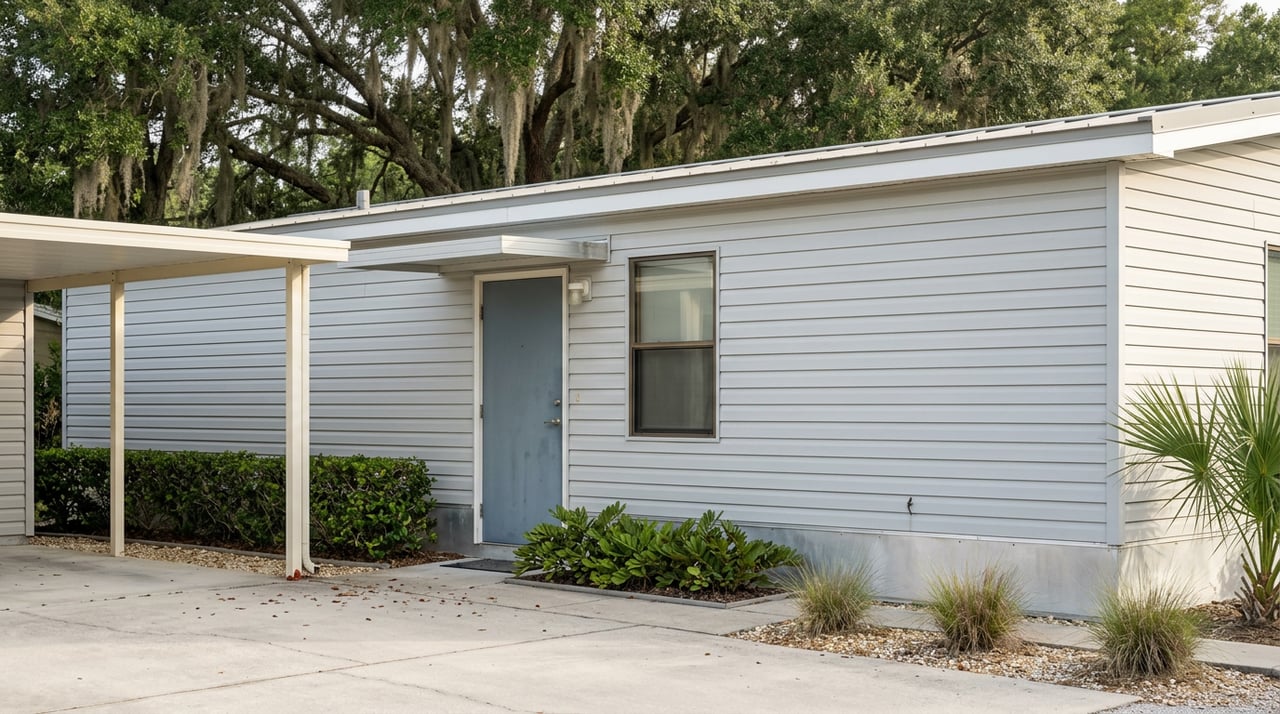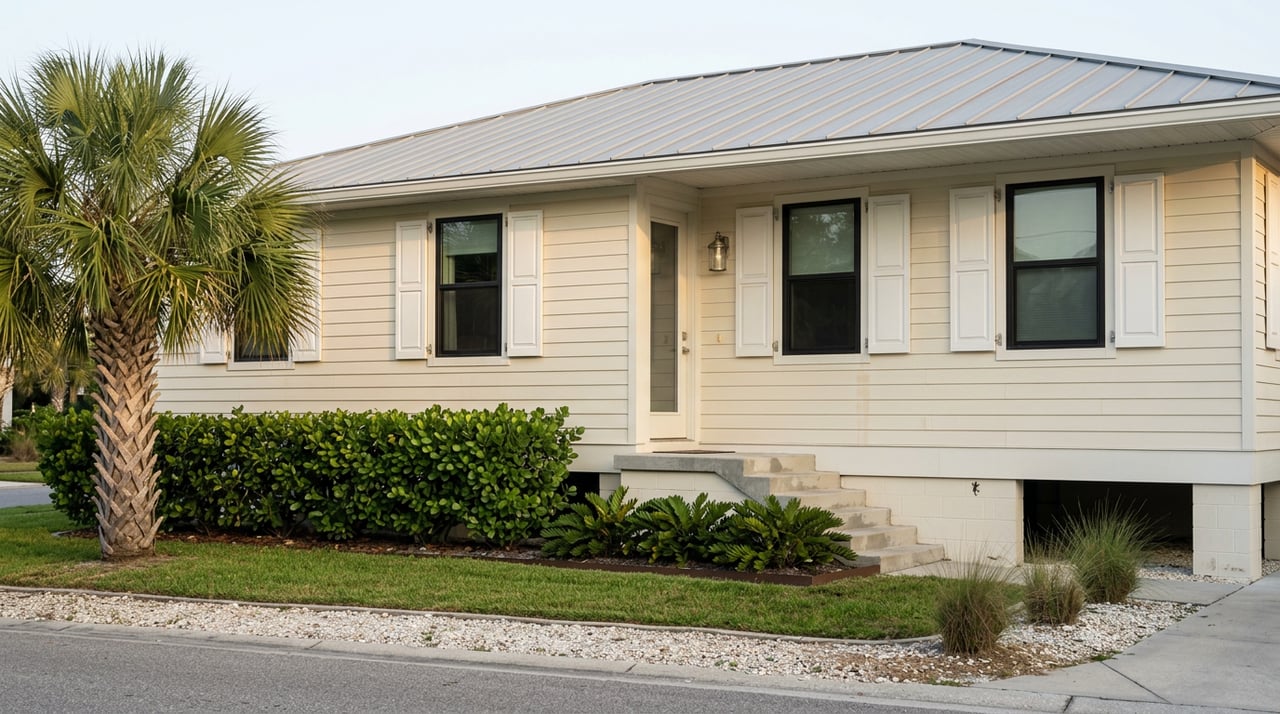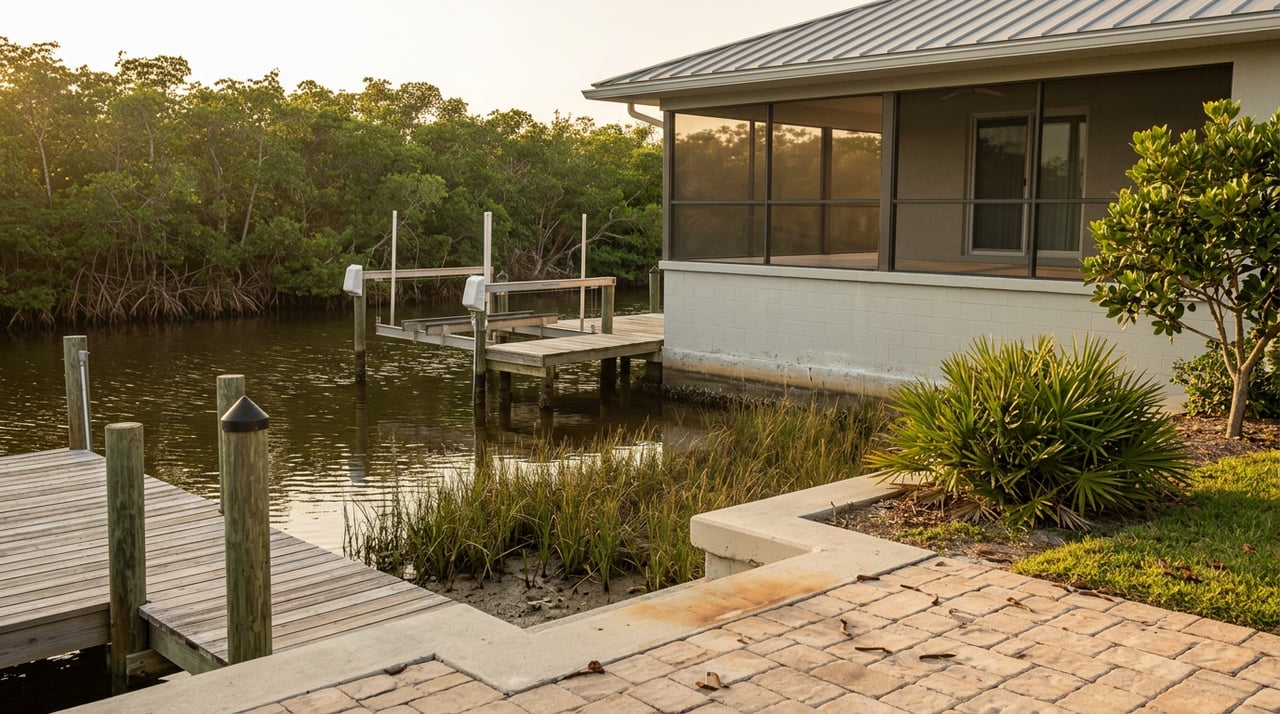
Two listings come up in the same afternoon, both under $750,000, both in Northwest Bradenton, both twenty minutes from the same boat ramp. One sits on open water in Palma Sola Bay. The other backs up to McLewis Bayou, a quieter, narrower stretch that the listing sheet flags as brackish frontage. Most buyers walk the bay house first because the water looks bigger and the sunset looks better in the listing photos. Then they ask their agent about adding a larger dock, and the answer changes depending on which house they buy, and not in the direction most people expect.
The bay lot, sitting in water the state has classified as an Outstanding Florida Water, gets a smaller no-permit dock allowance than the bayou lot does. The quieter address, the one that reads like the consolation prize, often comes with more room to build.
What "Brackish" Actually Means on a Bradenton Listing Sheet
Brackish water frontage is a distinct category in local MLS data, filed alongside Canal-Saltwater and Freshwater Canal with Lift to Saltwater Canal rather than folded into either one. It shows up on tidal creeks and bayous where fresh water draining off the land mixes with salt water pushed in by the tide, which describes a meaningful slice of Bradenton's waterfront inventory.
The clearest local example is McLewis Bayou in Northwest Bradenton, a tidal arm that connects to the Manatee River and has carried several waterfront listings over the past year, including estates and renovated homes marketed specifically for their bayou position. Wares Creek, a five-mile tidal stream that winds through downtown Bradenton before draining into the Manatee River, is another. It has its own neighborhood association, its own history of community cleanups, and its own place on the Manatee County Water Atlas. Farther east, the River Point of Manatee community lists Canal - Brackish as its own filterable frontage type in local listing data, right alongside Canal - Saltwater and Freshwater Canal with Lift to Saltwater Canal, which confirms this is a recognized, searchable property category rather than a marketing label someone invented for a listing description.
The Manatee River itself is the reason so much of this frontage exists. Below the dam at Lake Manatee, the river becomes an estuary, and estuaries are where brackish water lives by definition. That mixing zone is also where manatees, alligators, and occasionally a bull shark near the low-lying outlet show up in the same stretch of water, which is worth knowing before anyone puts a dock or a swim ladder in without checking with a neighbor first.
None of this makes brackish frontage a lesser product. It makes it a different regulatory category, and that category comes with an advantage most buyers never hear about until they are already asking a contractor for a dock quote.
The Permitting Math Behind the "Better" Address
Florida's dock permitting rules give small, single-family docks an exemption from the full environmental permitting process, but the size of that exemption depends on where the water sits. In most waters, a private dock of 1,000 square feet or less can proceed without a full state permit. In water designated an Outstanding Florida Water, that exemption drops to 500 square feet.
Most of the bay water in Sarasota and Manatee counties carries that designation, including Palma Sola Bay, Anna Maria Sound, and Sarasota Bay itself. What typically does not carry the same designation are the natural and artificial tributaries that feed into those bays, according to guidance published by FL Waterfront, a resource that tracks Florida's environmental permitting rules for waterfront owners. A brackish bayou or creek that empties into an Outstanding Florida Water is usually treated as its own, separately regulated body rather than an extension of the bay it feeds.
That distinction is the whole thesis of this post. The open-bay lot that looks like the upgrade sits under the stricter cap. The tributary lot that reads as the quieter, lesser address often sits under the more generous one. A buyer planning a dock in the 600 to 1,000 square foot range, which is not unusual for a boat lift plus a covered slip plus a walkway, may be able to build it without a full state permit on the brackish bayou and would need to clear that additional permitting step on the open bay.
This does not mean brackish frontage is permit-free. Local jurisdiction, the Army Corps of Engineers, and county rules still apply everywhere. The Florida Department of Environmental Protection's dock permitting guidance is the authoritative source for confirming what applies to a specific parcel, and every buyer under contract on waterfront property should ask their agent to pull the exact classification for that lot before assuming either way.
What the Difference Actually Buys You at the Dock
For a buyer comparing two similarly priced properties, the practical translation looks like this. A brackish-frontage lot on a tributary that has not been designated an Outstanding Florida Water can typically add a dock up to 1,000 square feet through the state's exemption process, which is faster and cheaper than the standard permitting track. A bay-frontage lot in an Outstanding Florida Water is capped at 500 square feet before the buyer needs a full Environmental Resource Permit, which adds both time and cost to the project.
This matters most to buyers who plan to build new or expand an existing dock rather than buy a house with a dock already in place. It also matters to anyone comparing a canal home to a bayou home purely on the assumption that closer to open water always means fewer obstacles. The obstacle in this case is not the water itself. It is the paperwork attached to the water, and that paperwork runs backward from what most buyers assume.
The Maintenance Bill You Should Ask About Before You Ask About the View
Brackish water carries its own upkeep pattern, and it is worth pricing into an offer the same way a buyer would price in a roof age or an HVAC replacement.
Marine contractors who work Gulf Coast canals consistently flag the same failure points in tidal, brackish environments: rust at joints and metal fasteners, corrosion on pilings near the waterline, and cap cracking on seawalls where embedded steel has started to expand. These are not saltwater-specific problems. Warm, tidal, brackish water accelerates the same corrosion cycle that pure saltwater does, and the daily tidal swing that defines brackish canals means hardware gets wet, dries, and gets wet again far more often than it would on a still freshwater pond.
That is the argument for a dedicated marine inspection before closing on any brackish-frontage property with an existing dock, seawall, or boat lift, separate from the standard home inspection. A diver or camera inspection of pilings and the base of a seawall catches the kind of hidden deterioration that looks fine from the yard and turns into a five-figure repair request six months after closing.
It is also worth a direct conversation with an insurance agent before writing an offer. Standard homeowners policies frequently treat docks, lifts, and seawalls as detached structures with limited built-in coverage, and waterfront owners often need a specific endorsement or a separate floater to cover them at replacement cost rather than actual cash value. That conversation belongs in the financing and insurance shopping phase, not after the inspection period has closed. Our guide to financing waterfront homes in Bradenton walks through how lenders and insurers typically approach these properties.
Reading the Listing Sheet Like Someone Who Already Knows This
Before writing an offer on any Bradenton waterfront property, brackish or otherwise, a few questions are worth asking directly rather than assuming the answer from the water frontage field alone.
- Which specific water body classification applies to this parcel, and is it designated an Outstanding Florida Water
- Does the existing dock, if any, have a permit on file with the county or the state, and does that permit transfer with the sale
- Has the seawall or dock had a marine inspection in the last two years, and can the seller produce it
- What does the current homeowners policy actually cover on the dock, lift, and seawall, separate from the house itself
Buyers weighing a brackish canal against an open bay lot, a bayou against a freshwater lake connection, or any combination of Bradenton's water types should treat this as one factor among several, alongside boat depth, bridge clearance, and proximity to open water covered in our broader look at living on boatable water in Bradenton.
FAQ
Is brackish water frontage less desirable than saltwater frontage? Desirability comes down to what a buyer wants from the water. Brackish canals tend to offer calmer conditions and, as covered above, sometimes more generous dock permitting. Open bay and saltwater frontage often trade that flexibility for bigger views and more direct Gulf access.
Does salinity affect flood insurance separately from homeowners insurance? Flood insurance is governed by FEMA flood zone designation, which applies regardless of whether the water is fresh, brackish, or saline. Homeowners insurance is where the corrosion and marine-structure coverage questions come in, and that is a separate conversation with your carrier.
Can a dock built under the exemption later be expanded? Any expansion beyond the exempt size, or any change in a designated water body's status, can trigger the full permitting process regardless of what existed before. Anyone planning to grow into a larger dock down the road should confirm the rules for that specific parcel rather than assuming the original exemption covers future work.
Brackish water frontage in Bradenton rewards buyers who read past the listing photo and into the classification behind it. If you are comparing bayou, bay, and river addresses and want the permitting and inspection picture pulled together before you write an offer, Smith Garcia Group can walk the specific parcel with you. Schedule your market consultation and we will get into the details that matter before you are under contract, not after.